In Labrador, the local anglers favor spinning gear for sea trout. Eyes opened wide, seeing Steve and me on the rocky shore with our fly rods tucked under our ams, stripping line with both hands. They opened even wider at the sight of us releasing sea run Brookies. By noon on our second day, we started to draw a crowd.
The word was out that the sea trout were in at Buckle's Point. Two CFA's (Come From Aways) were forking them in with fly rods - and throwing them back! No one had ever heard of such foolishness. Local anglers arrived by the truckload to get in on the action.
They weren't long finding out there wasn't much action to be had on the spinning rod. Catches were few and far between, except for those alien fly fishers with their annoying habit of releasing trophy trout. When a kid came up to me and asked if he could have the 20" trout I was releasing, I probably should have said yes. Instead, I gave the boy a purple Cardinelle fly and invited him to catch his own.
About that time, Steve approached me and said, "I've been chatting with a fellow over there for the past half hour. He wants us to come up to his house for a cup of tea and some smoked trout. What do you think?"
And that's how we came to meet Uncle Parker, and his nephews, Gavin, and young Bobby. The three of them were licensed guides, and they were there out of pure curiosity. They wanted to see with their own eyes what all the fuss was about on Buckle's Point - two guys fishing in the bay with fly rods!
I'll make a long story short by saying that we spent the night tying flies, drinking 12 year-old scotch and smoking cigars at young Bobby's. The next morning, we were back at Buckle's Point with Parker. Steve told me later that, at one point, he looked up the shore and saw half a dozen local anglers with fly rods tucked under their arms, stripping like madmen.
Here are a few tips about fly fishing in salt water:
Use a full sinking line - it will be no fun to cast with, but absolutely essential for getting the fly to where the fish are.
Stand on a high rock near shore, if possible. There are three advantages to this - the first is better visibility into the water, the second is less risk of smashing your fly on the rocks behind you, the third is achieving maximum casting range.
Speaking of visibility, wear a broad-brimmed hat and polarized sunglasses. Position yourself so that there is an area of sandy bottom nearby, if possible. Sea trout can be very difficult to see in salt water, except when they cross a patch of light sandy bottom.
In general, cast as far as you can, and let the fly sink. Tuck your rod under your arm and strip hard and fast with both hands.
Use a stripping basket. I learned this in Long Beach, California, fishing for Corbina. A stripping basket attaches to your waist with a belt and allows for better line control. It's not absolutely necessary, but makes the whole business a lot safer and more enjoyable. If you don't use one, be prepared to spend a lot of time freeing the line from tangles with rocks and seaweed at your feet. You can spend from $20 to $100 for a stripping basket or you can make your own for less than $10.
A marabou fly, such as a Cardinelle, or Wooly Bugger has a seductive pulsating action that trout seem to go for. Tie them big - you want something at least three inches long. I like to tie them with two contrasting colors of marabou - purple and pink, pink and yelow, or red and white are good choices.
Always rinse your rod, your reel, and any flies you might want to use again in fresh water after a day in the salt.
Good Luck and Good Fishin'!
-Random Phrump
Monday, March 10, 2008
Buckle's Point Revisited - Part 2

Saturday, March 1, 2008
Buckle's Point Revisited - Part 1
 The truck rolled to a stop near the rocky shore on Buckle's Point. Steve and I assembled our rods, and prepared to engage the sea trout of Forteau Bay. We had heard that 3 and 4 pounders were sometimes caught here by locals using spinning gear. We had to give it a try with our fly rods.
Steve headed left along the shore, toward the river's mouth, and I turned right towards the open sea. Standing on a high rock, casting as far as I could, I observed the motion of the fly in the water. Occasionally, a fish would chase the fly into the shallows, then turn away. About that time Steve hollered, "Fish on!" and I watched him land a gorgeous 16" sea trout.
We compared notes that evening in the Basque Dining Room of the Northern Light Inn at L'Anse-au-Clair. Steve told me his rig had included a sinking line and a 'Lester, the Lobster' salmon fly. After dinner, we enjoyed a local treat - a glass of Cloudberry (Bakeapple) liqueur on the rocks - the rocks, in this case, being 5,000 year old ice, harvested from an iceberg in the Strait of Belle Isle.
The next morning we packed up the truck and went through the motions of heading for the ferry in Blanc Sablons, but our conversation kept returning to Buckle's Point. I hadn't solved the mystery yet of saltwater fly fishing for trout. We flipped a coin in the parking lot - heads, the trout - tails, the ferry. Two, or three times that loonie came up tails, but Steve finally cussed it into submission, and so we made for Forteau Bay.
There were two men and a boy fishing with spinning rods outside the DFO-posted boundary signs. Beyond the signs, on this scheduled Atlantic Salmon river, it was fly-fishing only - off-limits to non-residents like us, without a guide. We chose a spot near, but not too near the other fishermen, and geared up. Thinking of Steve's rig, I wasn't long changing to a full sinking line, but I opted for a big marabou fly, a Cardinelle. I really liked the way the fly worked in the water. It seemed the faster I stripped line, the more often I would get fish to follow it in, sometimes right to the rocks at my feet.
I remembered seeing some saltwater anglers on a TV show using a two-handed stripping retrieve, with their rods tucked under their arms. At first, it felt awkward, but I could strip line much faster with two hands. Furthermore, the motion of the fly changed subtly - it now had a rapid dart left/dart right pattern instead of a steady trajectory.
About that time, I noticed a small pod of fish approaching, They were cruising parallel to the shoreline, and I cast to intercept them. Letting the fly sink until the fish were almost on top of it, I tucked the rod under my arm and stripped, with both hands, as fast as I could. To my amazement, the whole school turned to give chase, and one of them nailed it! I had just hooked an 18" sea trout in salt water - a first for me.
I told Steve about my new technique and he gave me a look that said, "whatever floats your boat..." and went back to his fishing. But I had found a method that worked, and it worked well. In the next hour, I released two more trophy sea trout. That's when Steve got interested in what kind of fly I was using. I should have said "a Rusty Rat", but I gave him one of my #2 Cardinelles. Not too much later, I looked to my left and there was Steve - rod tucked under his arm, stripping line with both hands, and a monster sea trout closing in on his fly. "Got him!" he cried. I hurried with the net to help land a trout that looked to be 4, maybe 5 lbs. What a fish! Outdone again, I've learned that's what I get for sharing my secrets with Steve.
Next post, I will share with you what I have learned about fly fishing in saltwater, including some tips to make it more productive, safer, and more enjoyable. I'll also have a few words to say about the local anglers' response to our success.
Good Luck and Good Fishin',
-Random Phrump
Phot0 by Drew Dobson
Friday, February 29, 2008
Gavin's Pocket
 When we rolled into Forteau, my two sons, Drew and David, and I weren't long hearing about the Atlantic Salmon fishing action so far that summer.
"Gavin's been 'avin' a good season, Skipper!" said Doug. "'e's got a 'oney 'ole we calls 'Gavin's Pocket'. By Jeezus, 'e's 'auled a 'few outta dat, da year, eh Mona?"
"'e's not da only one - I say ye got yer share, if ya wants to know da truth" cried Mona.
We geared up and headed for the river, with Gavin as our guide. At one pool, we saw fish, but got ne'er a raise. A good walk downstream, Gavin showed us his 'pocket'.
"I was fishin' in da middle, dere, " he said. "I always gives dat a flick on me way d-d-d-down by. Dis one day, it was blowin' a gale. I'se just after tyin' on a bug when da wind takes it clean outta me 'and. She lands right in dat pocket dere, behind dat rock, and kinda d-d-d-dances across da surface. Outta da corner of me eye, I seen dis fish make a d-d-d-dodge fer it - fired back and B-B-B-B-Bango! I 'ad 'im!"
Gavin had indeed found a 'honey hole' in a place most people would walk past without wetting a line. Close to shore, it was hard to believe that a salmon would lie there, but Gavin's Pocket produced fish for us all week. There are lessons in this:
- There is no substitute for a good local guide, especially when you have a limited amount of time to fish. It takes much of the guesswork out of the equation. A good guide will put you on fish - it will be your job to catch them.
- Don't ignore shallow water, or water very close to shore - big fish will rest there if there is some cover. That cover could be a corrugated surface caused by wind, or current. It could be the cover of darkness, or an overhanging limb.
- For an added bonus, salmon lying in shallow water can be more likely to take a fly, particularly a dry fly, than if they were lying at the bottom of a deep hole.
- Random Phrump
Photo by: Random Phrump
Tuesday, February 5, 2008
HMS Raleigh - Point Amour Light
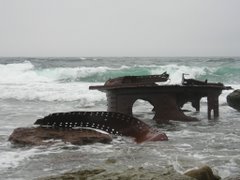
 In 1922, HMS Raleigh, the flagship of the British fleet, ran aground while taking evasive maneuvers to avoid an iceberg near Point Amour, Labrador. She was bringing the officers across the Strait of Belle Isle for salmon and sea trout fishing at Forteau. They tried in vain to salvage her - in the end she was scuttled, blown to smithereens by explosives.
84 years later, Doug Trimm took my son, Drew, for a stroll on the beach and showed him the wreck, and how to find pieces of cordite among the beach stones and shards of rusted metal. While they combed the beach, I couldn't help thinking,
"How drunk was the man on watch?"
Today, the lighthouse is a fascinating museum - climb to the top and enjoy a spectacular view of coastal Labrador. You will see whales and icebergs in the summer months, and there are world-class angling opportunities for Atlantic Salmon and sea-run Speckled Trout to be had - almost worth banging up a battleship for!
Good Luck and Good Fishin'!
-Random Phrump
Photo: Drew at Point Amour Light - Random Phrump